
From an API specification to an explicit command.
A Rust dispatcher owns specification review and integrity checks; providers own transport and authentication. The released binary makes that boundary inspectable.
Follow the architecture
- API specification
- Explicit review
- Bounded catalog
- Provider boundary
The dispatcher boundary
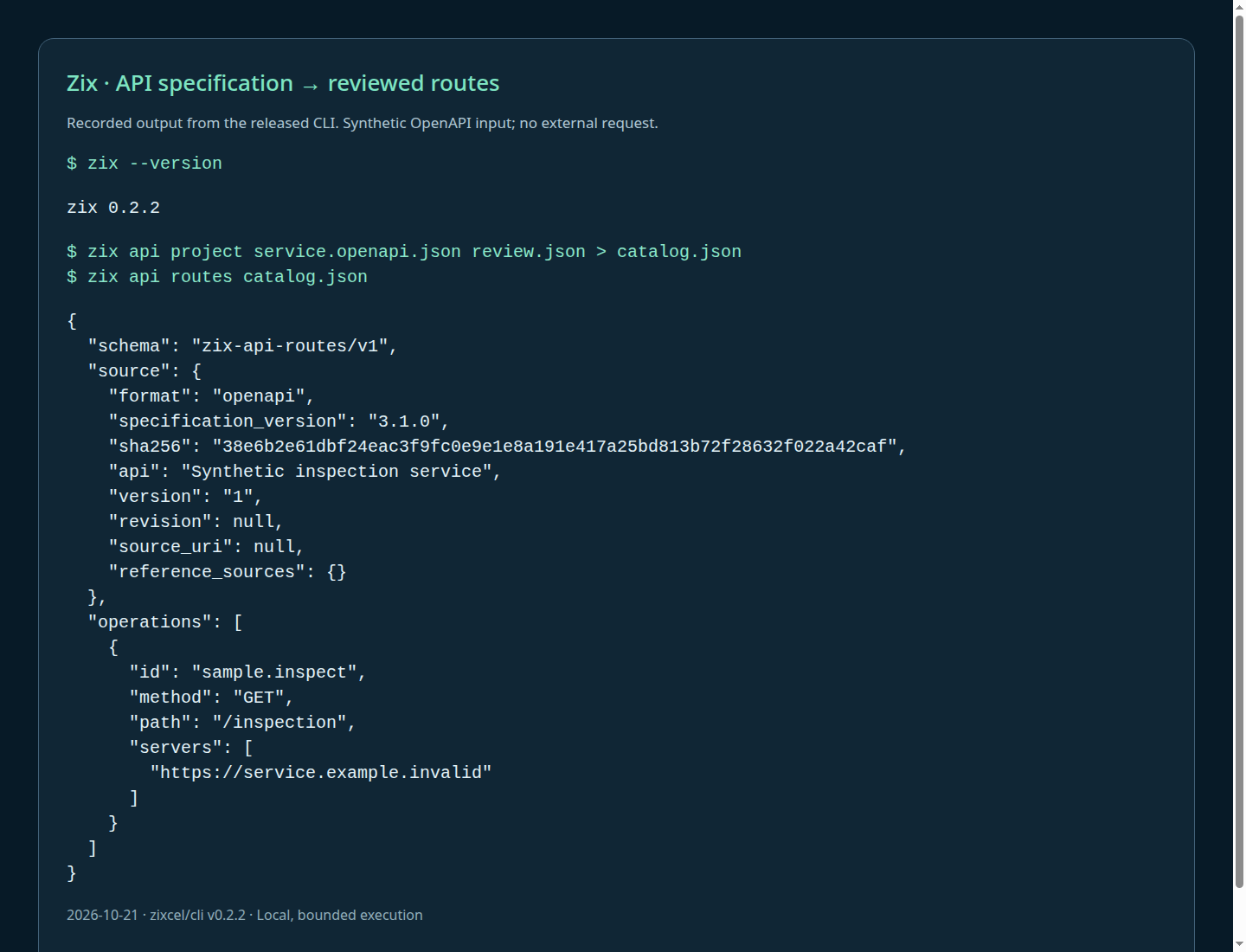
Separate specification input, explicitly selected operations, source hashes and provider execution contracts. The recorded run parses a synthetic OpenAPI document and extracts the GET /inspection route.
Parsing does not grant authority
Catalog projection and route inspection are local operations. An unbound operation is not silently connected to authentication or network execution. A real provider action requires a separate explicit contract.
Trade-off
Keep common admission logic separate from provider-specific implementations instead of collecting every integration into one large CLI. Generality must not silently broaden authority, and parsing a specification is not proof that a live operation is safe.
Verification with a released binary
Run version, api project and api routes with v0.2.2 and retain actual inputs and outputs in examples/zix. The observation uses no credential, external request or live data mutation. Group-writable catalog input was refused as designed.
Reproduce and inspect
Inspect the inputs, recorded output and implementation.